
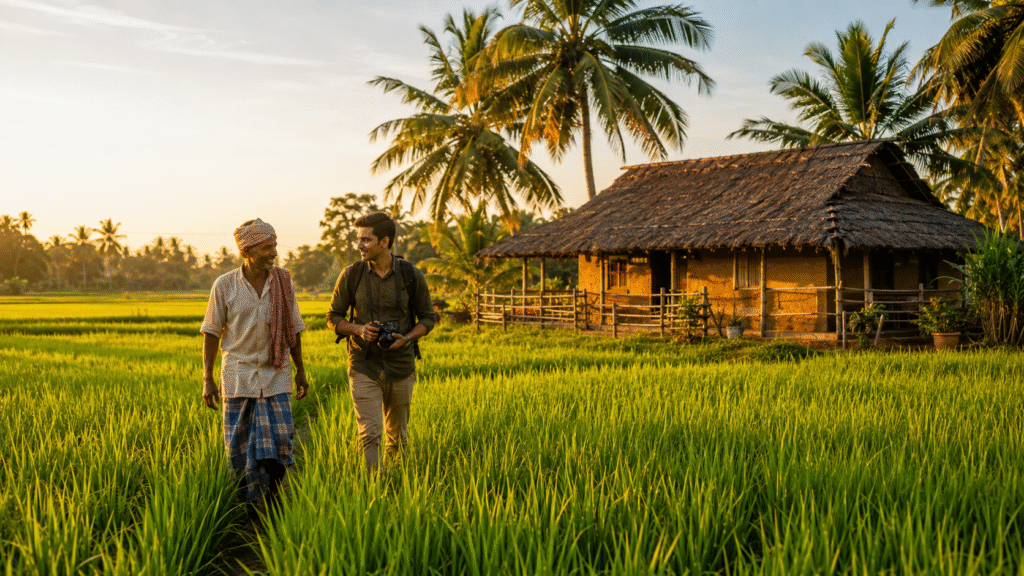
Every farmer knows the anxiety of a single bad monsoon. One flood, one price crash, one pest attack, and a year of work is gone. Agri-tourism doesn’t fix the weather — but it gives a farm a second way to earn, one that doesn’t depend on the market price of paddy or vegetables at all. That’s why it’s now central to India’s push to double farmer income, and why Odisha’s government has started backing it with real policy and money.
The global agri-tourism market was valued at around $42.5 billion in 2019 and is projected to reach nearly $63 billion by 2027, growing at close to 13% a year. In Odisha, roughly 84% of households are rural and depend on agriculture, which shows just how much is riding on finding farmers a second, more stable source of income.
What agri-tourism actually means
Agri-tourism means opening a working farm to visitors — not turning it into a resort, but letting people experience it. That can be a homestay in a farmhouse, a guided walk through paddy fields, a mango-picking afternoon, a cooking session using farm produce, or simply a meal served under a mango tree. The farm keeps farming. Tourism just becomes a second product it sells, alongside rice, vegetables, or millets.
Why it can double household income
The “Doubling Farmers’ Income” target was set by the Government of India in 2016, and the committee formed to study it flagged agri-tourism as one practical lever — because it attacks the core problem directly: most farm households have exactly one income source. Agri-tourism adds a second one that runs on a different calendar and a different set of risks.
The math is simple. A one-acre farm earning ₹80,000 a year from vegetables doesn’t need to grow to ₹1.6 lakh through better yields alone — it can get there by adding ₹80,000 from farm stays, tours, and direct sales to visitors who pay retail, not wholesale, prices. That’s the real shift: tourism income comes at consumer prices, not the depressed rates farmers usually get from middlemen.
The income streams typically look like this:
- Farm stays — rooms or cottages on the farm, rented to visitors
- Guided farm tours — paid walks through fields, orchards, or fisheries
- Farm-to-table meals — traditional Odia meals cooked with farm produce
- Direct produce sales — visitors buying vegetables, rice, or honey on-site, at retail prices
- Handicrafts and local goods — regional crafts, pickles, or textiles sold to visitors
A farm that sells an experience isn’t competing on the price of rice anymore — it’s competing on the price of a memory.
Odisha’s push into agro-tourism
In mid-2025, Odisha’s Department of Tourism and Department of Agriculture and Farmers’ Empowerment jointly organized a workshop bringing together agro-landowners, farmers, and policy experts to build a state agro-tourism roadmap. The state is now promoting dedicated Agro-Tourism Units — curated experiences ranging from farm stays and traditional cuisine to nature trails and hands-on farming — with support flowing through the Mukhyamantri Krushi Udyog Yojana (MKUY), which offers capital subsidies, training, and employment-linked incentives to agro-tourism entrepreneurs, delivered in partnership with the Agricultural Promotion and Investment Corporation of Odisha Limited (APICOL).
Places like Daringbadi in Kandhamal district, with its hills, orchards, and cool climate, have already been studied as models for what Odisha’s agri-tourism future could look like — a way to diversify income for a state where agriculture’s share of income is under growing pressure from cyclones and irregular rainfall.
What other states show us
Maharashtra got here first. Its Agri-Tourism Development Corporation (ATDC) has registered farm stays, vineyard tours, and orchard visits across the state, and its Agri-Tourism Vistar Yojana trains farmers in hospitality, hygiene, and how to sell farm produce directly to visitors. The lesson for Odisha and other states is that agri-tourism works best when it’s treated as a skill farmers are trained in, not just a signboard put up by the roadside.
Who else benefits, beyond the farmer
- Rural women, through self-help-group-led cooking, crafts, and homestay hosting
- Local youth, as guides, drivers, and hospitality staff, without needing to migrate to cities
- Artisans and small vendors, through demand for local crafts and produce
- The wider village economy, through better roads, connectivity, and visibility
The real challenges to plan for
Agri-tourism isn’t a guaranteed win. Where tourism income becomes far more profitable than farming, some landowners are tempted to quietly shift land away from crops altogether — which defeats the purpose. Monoculture regions growing mostly wheat or rice tend to attract fewer visitors than farms with orchards, livestock, or floriculture, since there’s simply less to see and do. Income is seasonal, peaking at harvest and festival periods and thinning out otherwise. And rural infrastructure — roads, power, clean water, and sanitation — is still catching up in many villages, which limits how many visitors a farm can comfortably host.
Thinking of starting an agri-tourism venture in Odisha? A good starting point is a farm with something distinctive to show — an orchard, a traditional cuisine, a craft, or a striking landscape — paired with even one clean, comfortable place for a visitor to stay or eat. Everything else can be built up gradually.
Where I stand on this
At Agribite Soil To Serve, this is exactly the model I believe in — farms that don’t just grow food but also share the story of how it’s grown, and get paid fairly for both. Doubling farmer income doesn’t need to wait for a perfect harvest every year. It needs a second door into the same farm, one that visitors are already willing to walk through.
Frequently asked questions
What is agri-tourism? Agri-tourism, also called agro-tourism, is the practice of opening working farms to visitors for activities like farm stays, harvest experiences, farm-to-table meals, and rural cultural immersion, so farmers earn extra income alongside crop production.
How does agri-tourism double farmer income? It adds a second, non-farm income stream on top of crop sales — through farm stays, guided tours, direct produce sales, local cuisine, and handicrafts. This diversification reduces dependence on unpredictable harvests and market prices and can meaningfully raise total household income.
What government schemes support agri-tourism in Odisha? Odisha’s Department of Tourism and Department of Agriculture and Farmers’ Empowerment jointly support agro-tourism units. The Mukhyamantri Krushi Udyog Yojana (MKUY), delivered with the Agricultural Promotion and Investment Corporation of Odisha Limited (APICOL), offers capital subsidies, training, and employment-linked incentives to agro-tourism entrepreneurs.
Which Indian state is a model for agri-tourism? Maharashtra is widely seen as India’s agri-tourism pioneer, through its Agri-Tourism Development Corporation (ATDC) and the Agri-Tourism Vistar Yojana, which trains farmers in hospitality, hygiene, and farm-produce sales.
What are the challenges of agri-tourism for farmers? Common challenges include land-use conflicts when tourism becomes more profitable than farming, seasonal income swings, weak rural infrastructure such as roads and sanitation, and lower suitability in monoculture regions that offer visitors less to see and do.
Sources: Doubling Farmers’ Income Committee (Government of India); Drishti IAS; KrishiCenter; Odisha Department of Tourism & Department of Agriculture and Farmers’ Empowerment (June 2025 workshop); CEEW; academic case study on Daringbadi, Odisha.