
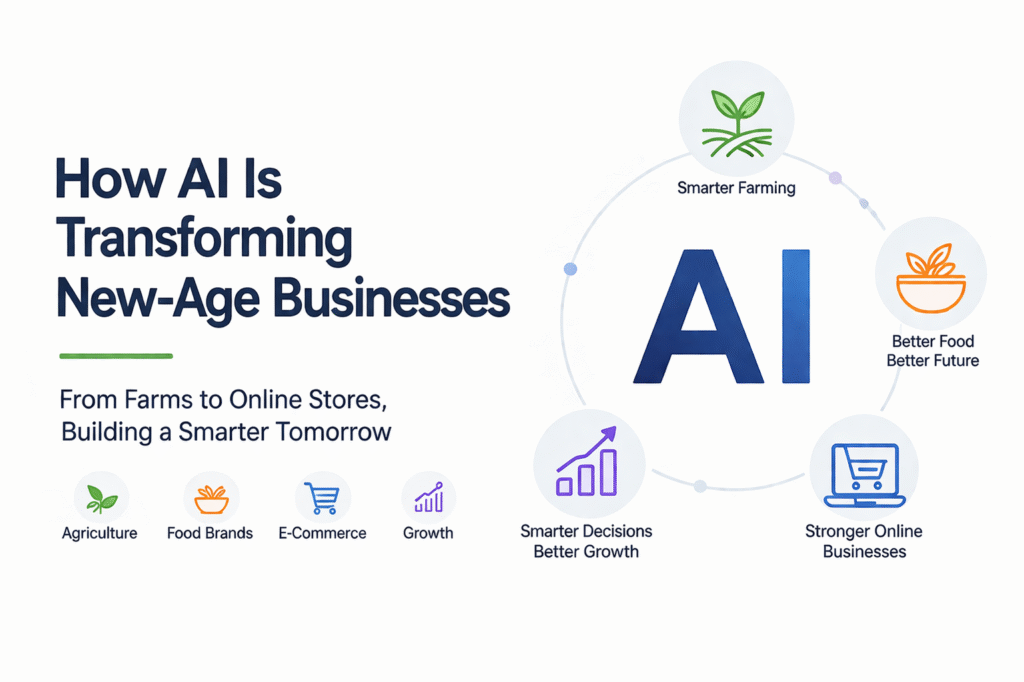
Artificial Intelligence is no longer a “tech industry topic.”
It has quietly entered every industry — agriculture, food brands, startups, e-commerce, marketing, and even small homegrown businesses.
We are living in a time where one smart business owner with AI tools can compete with large companies.
This article explores how AI is changing modern businesses and why the next generation of entrepreneurs must understand it.
The Rise of AI in Everyday Business
A few years ago, AI felt futuristic. Today, it’s practical.
Small brands are using AI to:
- Write content
- Predict sales
- Automates customer support
- Manage inventory
- Understand customer behavior
AI has become the new electricity of business — powering everything silently in the background.
The Shift From Manual Work to Smart Work
Traditional businesses depended heavily on:
- Manual data entry
- Guess-based decision making
- Large teams for repetitive tasks
- Expensive marketing campaigns
AI has changed the rules.
Now businesses can:
- Automate repetitive work
- Make data-driven decisions
- Personalize customer experiences
- Grow faster with smaller teams
The result?
Less effort. More impact.
AI in Agriculture: The Beginning of the Supply Chain
The transformation actually starts from the farm.
Farmers and agri-startups are now using AI to:
- Predict rainfall and weather patterns
- Detect crop diseases early
- Optimize irrigation and fertilizer use
- Estimate crop yield before harvest
This means better quality produce, less wastage, and improved farmer income.
AI is helping agriculture move from uncertainty to predictability.
AI in Food Processing & Quality Control
Once food reaches processing units, AI continues to play a role.
AI systems can:
- Detect impurities and defects
- Monitor hygiene standards
- Predict shelf life
- Reduce production wastage
For food brands, this ensures consistency and food safety — two pillars of customer trust.
AI in E-Commerce: Understanding the Customer Mind
Online businesses generate huge amounts of data every day.
AI helps decode this data and turn it into action.
AI can answer questions like:
- What products will customers buy next month?
- Which products should be bundled together?
- When should discounts be offered?
- Why are customers leaving the cart?
Instead of guessing, businesses now predict.
Personalization: The New Marketing Superpower
Customers today don’t want generic experiences.
They want brands that:
- Understand their preferences
- Suggest relevant products
- Offer personalized deals
- Communicate at the right time
AI makes this possible by analyzing customer behavior patterns.
This leads to:
- Higher conversion rates
- Repeat purchases
- Strong brand loyalty
AI in Digital Marketing
Marketing used to be expensive and uncertain.
AI has made it smarter and measurable.
Businesses now use AI to:
- Write SEO blogs
- Generate social media content
- Optimize ads
- Segment customers
- Automates email campaigns
Small businesses can now compete with big brands without big budgets.
AI Chatbots: 24/7 Customer Support
Customers expect quick answers.
AI chatbots provide:
- Instant replies
- Round-the-clock support
- Multilingual communication
- Reduced support costs
It’s like having a customer service team that never sleeps.
AI in Supply Chain & Logistics
AI also improves how products move from warehouse to customer.
It helps businesses:
- Forecast demand
- Optimize delivery routes
- Reduce inventory waste
- Improve warehouse efficiency
This leads to faster deliveries and happier customers.
Why AI Is a Game-Changer for Startups
Startups usually struggle with:
- Limited budget
- Small teams
- High competition
AI acts as a digital team member that works 24/7.
It allows startups to:
- Automate operations
- Scale faster
- Reduce costs
- Focus on innovation
AI levels the playing field.
Challenges of AI Adoption
Like any technology, AI comes with challenges:
- Learning curve
- Data privacy concerns
- Need for digital skills
- Integration with existing systems
But the long-term benefits are far greater than the initial effort.
The Future of AI in Business
The coming years will bring:
- Voice-based shopping
- Hyper-personalized online stores
- AI-driven product development
- Automated supply chains
- Predictive business planning
AI will not replace entrepreneurs —
It will empower them.
Final Thoughts
Artificial Intelligence is not the future anymore.
It is the present.
Businesses that embrace AI today will:
- Work smarter
- Grow faster
- Serve customers better
- Stay ahead of competition
The real question is no longer “Should we use AI?”
The real question is “How soon can we start?”